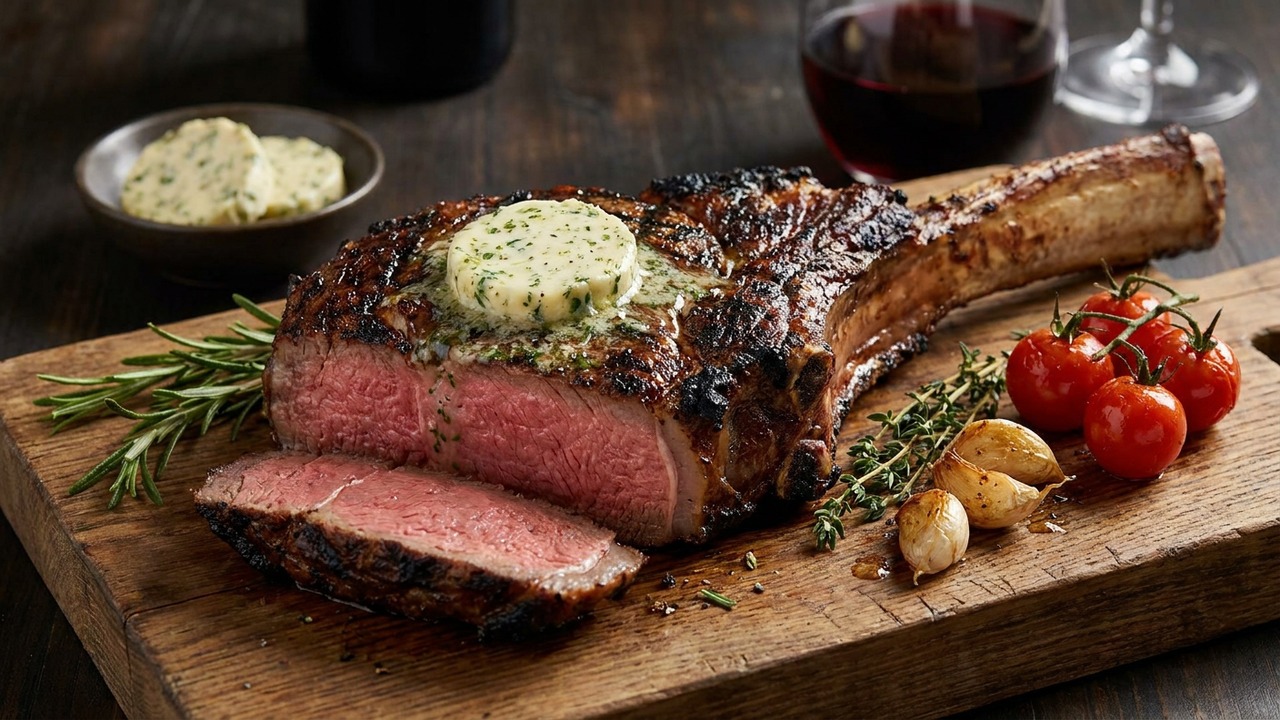
Grilled Steakhouse Tomahawk with Compound Herb Butter
A dramatic steakhouse-style tomahawk grilled at home using a two-zone reverse-sear method for an even medium-rare interior and deeply caramelized crust. Finished with a bright compound herb butter, this steak is built for celebrations or an impressive weekend dinner.
Ingredient Spotlight
Tomahawk ribeye (bone-in), 2–2.5 lb
A tomahawk ribeye is a ribeye steak frenched with a long rib bone left intact, named for its resemblance to a tomahawk axe and popular in American steakhouse cooking. It’s prized for abundant marbling and a rich, beefy-buttery flavor; the long bone makes a dramatic presentation and can slightly change cooking time. Find it at butcher counters, specialty meat markets, or upscale grocery stores (or ask your butcher to French and leave the bone long); good substitutes are a bone-in ribeye (rib steak) or a boneless ribeye/entrecôte, though presentation and cooking characteristics will differ.
Ingredient Spotlight
Neutral high-heat oil (grapeseed or vegetable)
Grapeseed oil is a neutral-flavored oil made from grape seeds (a winemaking byproduct) with a fairly high smoke point, commonly recommended for searing and high-heat cooking when you don’t want added flavor. It tastes very mild and won’t compete with herbs or butter in a recipe. Available in most supermarkets and specialty food stores; suitable substitutes include refined avocado oil, refined canola oil, safflower oil, or peanut oil for similar heat tolerance and neutral flavor.
Jake Woods's note
"This recipe highlights the show-stopping tomahawk while using a reliable two-zone reverse sear so home cooks can reproduce steakhouse results. It shines for dinner parties or milestone meals when you want theater and exceptional flavor."
About This Recipe
A tomahawk isn’t just a steak — it’s a moment. This recipe leans into the theatrical bone-in presentation while keeping technique pragmatic: a two-zone reverse sear gives the thick ribeye an even, rosy medium-rare from edge to bone and then rewards you with a deeply caramelized crust when it hits the hot side of the grill. The compound herb butter—bright parsley, lemon zest, thyme and a hit of garlic—cuts through the beef’s richness and melts into the exterior, giving each slice a glossy finish and lively lift.
What makes this version work for home cooks is the balance of control and flavor. You don’t need fancy equipment beyond a probe thermometer and a grill that can do two zones; the indirect phase lets the interior come up gently so the final sear doesn’t overcook, and chilling the butter ensures tidy presentation and fast melting during the rest. Make this when you want to impress without improvising—there’s planning involved, but the payoff is a restaurant-grade steak that slices beautifully and tastes like an occasion.
Ingredients for Grilled Steakhouse Tomahawk with Compound Herb Butter
- 1/2 cup Unsalted butter (room temperature)
- 2 tbsp Fresh flat-leaf parsley, finely chopped
- 1 tbsp Fresh thyme leaves, chopped
- 2 cloves Garlic, minced
- 1 tsp Lemon zest
- 2 tsp Kosher salt
- 1 piece Tomahawk ribeye (bone-in), 2–2.5 lb
- 1 1/2 tsp Freshly ground black pepper
- 2 tbsp Neutral high-heat oil (grapeseed or vegetable)
How to Make Grilled Steakhouse Tomahawk with Compound Herb Butter
Step 1: Make the compound herb butter
In a bowl, mash the room-temperature unsalted butter with chopped parsley, thyme, minced garlic, lemon zest and 1/2 teaspoon kosher salt until evenly combined. Shape into a log on plastic wrap, press tightly, then chill at least 20 minutes (freeze 10 minutes if you’re short on time) so the rounds will slice cleanly when serving.For this step
- 1/2 cupUnsalted butter (room temperature)
- 2 tbspFresh flat-leaf parsley, finely chopped
- 1 tbspFresh thyme leaves, chopped
- 2 clovesGarlic, minced
- 1 tspLemon zest
Step 2: Prep and season the tomahawk
Pat the tomahawk very dry with paper towels and trim any excessive fat if desired; leave the long frenched bone intact for presentation. Rub the meat lightly with neutral oil, then season liberally with the remaining kosher salt and freshly ground black pepper; let rest uncovered at room temperature 30–45 minutes (or refrigerate uncovered up to 24 hours for a dry-brine — bring back to room temp before grilling).For this step
- 1 pieceTomahawk ribeye (bone-in), 2–2.5 lb
- 1 1/2 tspFreshly ground black pepper
- 2 tbspNeutral high-heat oil (grapeseed or vegetable)
Step 3: Set up a two-zone grill for reverse sear
Preheat one side of your grill to high (direct sear zone ~500–600°F / 260–315°C) and leave the other side off or at low heat for indirect cooking; if using a gas grill, light only half the burners. Place a probe thermometer in the thickest part of the steak and position the steak over the cool zone with the lid closed for the indirect cook.Step 4: Cook indirectly to target internal temperature
Cook the tomahawk on the indirect side with the lid closed until the internal temperature reaches about 110–115°F (43–46°C) for medium-rare — typically 20–35 minutes depending on thickness. Use your probe thermometer to monitor; your goal is an even internal temp before the final sear rather than a fast high-heat cook.Step 5: Sear over high direct heat for a crust
Move the steak to the hot direct zone and sear 1–2 minutes per side to develop a deep, caramelized crust, rotating for even char and searing the exposed fat and bone edge briefly. If flare-ups occur, move to the cooler zone briefly then return to the sear; finish when the crust is dark and the probe reads about 125–130°F (52–54°C) for medium-rare after carryover.Step 6: Rest, finish with herb butter, and slice to serve
Tent the tomahawk loosely with foil and rest 10–15 minutes so juices redistribute and carryover raises the temperature a few degrees. Slice the compound butter into rounds and melt over the steak as it rests, then carve the meat off the bone, slice across the grain into thick pieces, and serve with extra butter on top.


- In a bowl, mash the room-temperature unsalted butter with chopped parsley, thyme, minced garlic, lemon zest and 1/2 teaspoon kosher salt until evenly combined. Shape into a log on plastic wrap, press tightly, then chill at least 20 minutes (freeze 10 minutes if you’re short on time) so the rounds will slice cleanly when serving.
- Pat the tomahawk very dry with paper towels and trim any excessive fat if desired; leave the long frenched bone intact for presentation. Rub the meat lightly with neutral oil, then season liberally with the remaining kosher salt and freshly ground black pepper; let rest uncovered at room temperature 30–45 minutes (or refrigerate uncovered up to 24 hours for a dry-brine — bring back to room temp before grilling).
- Preheat one side of your grill to high (direct sear zone ~500–600°F / 260–315°C) and leave the other side off or at low heat for indirect cooking; if using a gas grill, light only half the burners. Place a probe thermometer in the thickest part of the steak and position the steak over the cool zone with the lid closed for the indirect cook.
- Cook the tomahawk on the indirect side with the lid closed until the internal temperature reaches about 110–115°F (43–46°C) for medium-rare — typically 20–35 minutes depending on thickness. Use your probe thermometer to monitor; your goal is an even internal temp before the final sear rather than a fast high-heat cook.
- Move the steak to the hot direct zone and sear 1–2 minutes per side to develop a deep, caramelized crust, rotating for even char and searing the exposed fat and bone edge briefly. If flare-ups occur, move to the cooler zone briefly then return to the sear; finish when the crust is dark and the probe reads about 125–130°F (52–54°C) for medium-rare after carryover.
- Tent the tomahawk loosely with foil and rest 10–15 minutes so juices redistribute and carryover raises the temperature a few degrees. Slice the compound butter into rounds and melt over the steak as it rests, then carve the meat off the bone, slice across the grain into thick pieces, and serve with extra butter on top.
Grilled Steakhouse Tomahawk with Compound Herb Butter Tips
Use a probe thermometer
Insert the probe into the thickest part of the meat before you start cooking so you can monitor the slow rise during the indirect phase and stop at your precise target.
Try an overnight dry-brine
Season the tomahawk and refrigerate uncovered up to 24 hours to concentrate flavor and dry the surface for a better crust; bring back to room temperature before grilling.
Chill butter for clean slices
Firming the compound butter in the fridge or freezer for 10–20 minutes makes it easy to slice neat rounds that melt attractively over the steak at rest.
Trim fat selectively
Leave a good cap of fat for flavor and protection during the indirect cook, but trim any large flaps that will flare wildly during the sear.
Manage flare-ups smartly
If flames spike while searing, move the steak to the cooler zone briefly rather than dousing with water; return when the flare has settled to finish the crust.
Rotate for even char
Turn the steak 45 degrees during each side’s sear to build a uniform crosshatch and avoid over-charring any one spot.
Grilled Steakhouse Tomahawk with Compound Herb Butter Variations and Substitutions
Smoky coffee rub
Replace the salt and pepper with a mix of finely ground coffee, smoked paprika, brown sugar and a pinch of cayenne for an earthy, slightly sweet crust that plays well with the butter.
Citrus-herb twist
Fold in orange zest and a touch of minced rosemary to the compound butter for a brighter, Mediterranean-style finish that pairs well with lighter sides.
Dairy-free finishing oil
For dairy-free diets, make an herb-infused finishing oil by blending olive oil with parsley, thyme, lemon zest and garlic, and brush on the steak as it rests.
Sous-vide reverse sear
If you own a sous-vide, cook the tomahawk to 125°F in the water bath, chill briefly, then dry and sear on a smoking-hot grill or cast-iron for the same even medium-rare and crust.
How to Store and Make Grilled Steakhouse Tomahawk with Compound Herb Butter Ahead
Store leftover sliced steak in an airtight container in the refrigerator for up to 3 days; keep any unused compound butter wrapped and chilled for up to 1 week or freeze for 2–3 months. For reheating, warm gently in a low oven (about 250°F/120°C) on a rack until around 110°F, then flash-sear 30–60 seconds per side to refresh the crust, or slice and warm in a skillet with a splash of beef stock to avoid drying.
What to Serve With Grilled Steakhouse Tomahawk with Compound Herb Butter
Serve the tomahawk on a wooden board with the bone intact for drama and place butter rounds on top to melt into the slices as guests carve. Pair with roasted fingerling potatoes or charred broccolini, a simple horseradish crème fraîche or blistered mushrooms, and a full-bodied red like Cabernet Sauvignon or a smoky bourbon Old Fashioned.
Grilled Steakhouse Tomahawk with Compound Herb Butter FAQs
What internal temperature should I aim for?
For medium-rare, pull the steak from indirect heat at about 110–115°F before the sear, then sear until the probe reads 125–130°F after carryover. Use the probe for accuracy since thickness and grill heat affect timing.
How long should the tomahawk rest?
Rest the steak tented for 10–15 minutes; because it’s thick and bone-in, a full 15 minutes lets juices redistribute and allows the compound butter to melt into the surface.
Can I cook this without a two-zone grill?
Yes—use the oven for the indirect phase at 225–275°F until the internal temp reaches 110–115°F, then finish on a preheated cast-iron skillet or under a screaming broiler to develop the crust.
Why is the butter chilled before serving?
Chilling firms the butter so you can slice attractive rounds that melt slowly and evenly on the steak; it also lets flavors meld so the herb notes are more integrated.
How do I prevent excessive flare-ups?
Trim large fat flaps, sear over a clean grate, and keep a cooler zone ready to move the steak if flames spike; controlling the amount of rendered fat hitting the fire is the key.
Can I cook to a different doneness?
Yes—adjust final target temps: remove from indirect at about 120–125°F for medium and sear to 135–140°F, or lower for rarer results, always accounting for 5–10°F of carryover during rest.
About the author
Jake WoodsHello, I'm Jake. I started this recipe site with the idea that I hated recipe websites that overwhelm you with long stories and ads just to see plain content that's not helpful. My goal is to provide you with quality recipes, simple ideas and a fun cooking experience. There's lots of fun things to cook, and I think as you browse the site you'll find that TopShelf.Recipes is the place for quality recipes on the web.
See all recipes by Jake Woods →Ratings & Reviews
Did you make this recipe?
Be the first to share your experience.
Nutrition Facts
Per serving: about 1¼ cups
Nutrition values are estimated from USDA ingredient data and may vary based on preparation, brands, and portion sizes. Values are provided for informational purposes only.
Keep Reading
Guides & articles for this recipe

Healthy Eating
Gluten-Free Weeknight Grilling Plan
A 7-day gluten-free weeknight grilling plan with quick, family-friendly recipes, prep-ahead timelines, and a printable shopping list that spotlights late-summer produce and pantry staples. Includes clear cross-contamination safety tips and simple swaps to keep dinners fast and crowd-pleasing.

Cocktails & Drinks
Shakerless Cocktails for Backyard Grilling
Easy, tool-free cocktail recipes designed for backyard grilling and outdoor hangs. Find single-serve and batch formulas, quick portable infusions, improvised gear hacks, and simple cocktail pairings for grilled meats and vegetables.

Healthy Eating
Lean Labor Day Grilling Menu
A Labor Day grilling guide that swaps heavy BBQ classics for lighter, flavorful options—think lean proteins, charred vegetables, and low‑sugar sauces. Includes make-ahead meal prep, portioning tips, and a short shopping checklist for healthy, crowd-pleasing cookouts.
More from Grilling
View all Grilling recipes →
Quinoa and Black Bean Salad

Perfect Juicy Grilled Chicken Breasts (No Drying, 15 Minute Method)

Maple Mustard Glazed Grilled Chicken Thighs (Sweet Savory Weeknight BBQ)

Small Grill Alternatives to Beer-Can Whole Chicken: Spatchcock and Two-Zone Roast on the Grill

Labor Day Grilled Lobster Rolls with Charred Scallion Brown Butter & Lemon‑Herb Aioli

Spicy Grilled Shrimp Skewers with Garlic Lime Marinade

Bulgogi Smash Burger

Campfire‑Smoked Potato Salad with Mustard‑Bacon Vinaigrette — A Labor Day Grilling Side for Steak

Hanger Steak with Shallot Sauce
Ask me anything about this recipe — substitutions, scaling, techniques, timing.
Powered by AI · 6 questions per 5 minutes, 30 per day