Spritz Cookies
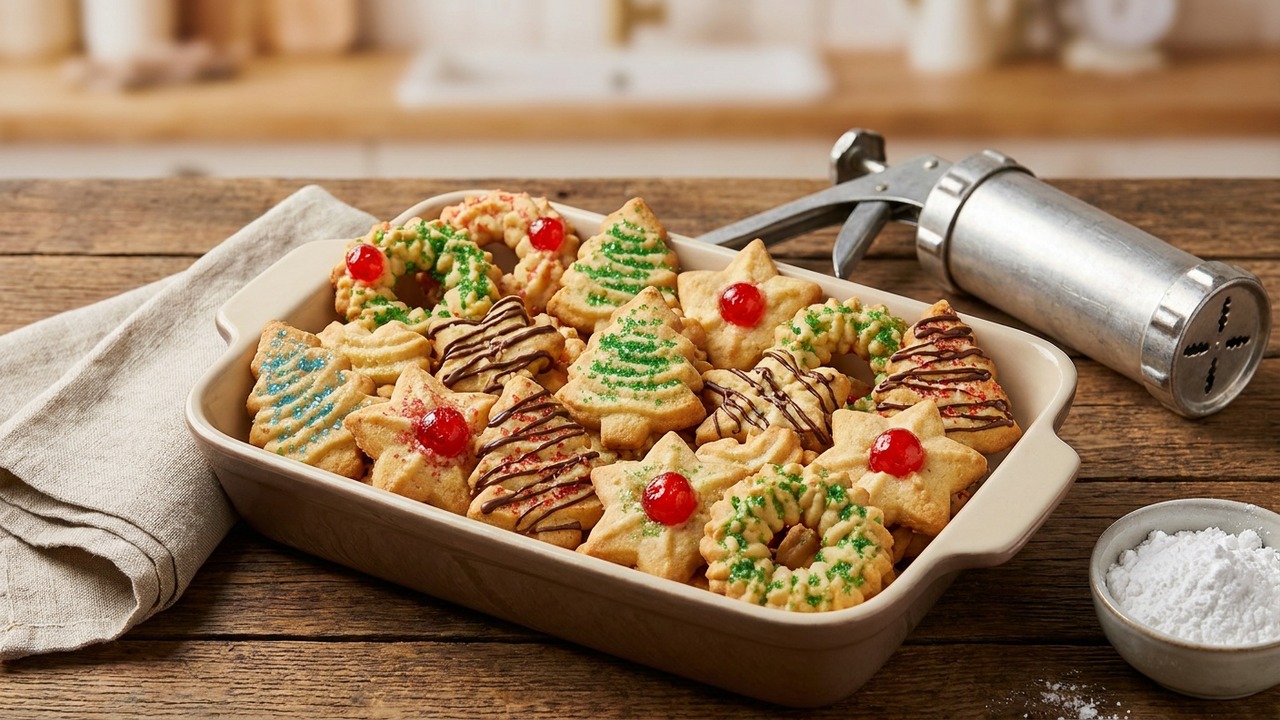
Buttery, tender spritz cookies made with a cookie press for perfectly shaped holiday treats. This recipe yields crisp edges and a melt-in-your-mouth center and includes tips for press technique and quick flavor variations for cookie exchanges.
Jake Woods's note
"These spritz cookies are a nostalgic holiday staple — ideal for cookie exchanges and decorating with colored sugars or sprinkles. Home cooks will love how reliably the cookie press produces uniform shapes and how easily the dough adapts to flavor twists."
About This Recipe
Spritz cookies sit at the sweet spot between nostalgic holiday craft and efficient party baking. These buttery, tender rounds have crisp, lacy edges and a melt-in-your-mouth center thanks to the cornstarch in the dough and a short, precise bake; the cookie press delivers uniform, decorative shapes in seconds so you can focus on flavors and finishes. This version uses just one egg and a modest amount of granulated sugar, so it browns lightly rather than deep caramelizing — that restrained sweetness lets vanilla or almond extract sing and keeps the texture delicate rather than firm.
It’s a great recipe for bakers who want impressive-looking cookies without fuss: a novice can achieve clean stars and wreaths with a little practice, and a seasoned cookie-exchange pro will appreciate how easy it is to switch disks, add cocoa or citrus zests, and decorate while the cookies are still warm. Pay attention to dough temperature — soft dough makes sticky, misshapen spritzes — and resist overmixing to preserve the tender crumb. In about 28 minutes from start to finish you'll have a tray of consistent cookies ready to plate, glaze, or bag for gifting.
Ingredients for Spritz Cookies
- 1 cup Unsalted butter, softened
- 3/4 cup Granulated sugar
- 1 large Large egg
- 1 tsp Pure vanilla extract
- 1/2 tsp Almond extract (optional)
- 2 1/4 cups All-purpose flour
- 1/4 cup Cornstarch
- 1/4 tsp Fine sea salt or kosher salt
How to Make Spritz Cookies
Step 1: Cream butter and sugar
In a large bowl or the bowl of a stand mixer fitted with the paddle, beat the softened butter on medium speed until smooth and pale, about 1 minute. Add the granulated sugar and continue beating until light and fluffy, about 2–3 minutes, scraping the bowl once or twice.For this step
- 1 cupUnsalted butter, softened
- 3/4 cupGranulated sugar
Step 2: Add egg and extracts
Beat in the egg until fully incorporated, then add the vanilla and almond extract (if using) and mix until combined. Stop and scrape the bowl so everything is evenly blended and the batter is uniform.For this step
- 1 largeLarge egg
- 1 tspPure vanilla extract
- 1/2 tspAlmond extract (optional)
Step 3: Incorporate dry ingredients
Whisk together the all-purpose flour, cornstarch, and salt in a separate bowl. Gradually add the dry ingredients to the butter mixture on low speed and mix just until a soft, cohesive dough forms — do not overmix. The dough should hold together but be soft enough to press; if it feels too loose chill 10–15 minutes.For this step
- 2 1/4 cupsAll-purpose flour
- 1/4 cupCornstarch
- 1/4 tspFine sea salt or kosher salt
Step 4: Fill the cookie press and pipe
Fit your cookie press with the desired disk and fill it with dough according to the manufacturer's instructions. Press cookies 1 inch apart onto an ungreased or parchment-lined baking sheet, reloading and wiping the disk if dough clogs. For cleaner shapes, keep the press perpendicular to the pan and press straight down without twisting; if dough sticks, chill the filled press 5–10 minutes before resuming.Step 5: Bake, cool, and finish
Bake at 350°F (175°C) for 7–9 minutes, or until edges just begin to set and the bottoms are very lightly golden. Transfer cookies to a wire rack to cool completely before decorating. For variations, stir in 1–2 tbsp cocoa powder for chocolate spritz, add 1 tsp citrus zest for lemon/orange, or top with colored sugar or a light glaze for a cookie exchange-ready presentation.


- In a large bowl or the bowl of a stand mixer fitted with the paddle, beat the softened butter on medium speed until smooth and pale, about 1 minute. Add the granulated sugar and continue beating until light and fluffy, about 2–3 minutes, scraping the bowl once or twice.
- Beat in the egg until fully incorporated, then add the vanilla and almond extract (if using) and mix until combined. Stop and scrape the bowl so everything is evenly blended and the batter is uniform.
- Whisk together the all-purpose flour, cornstarch, and salt in a separate bowl. Gradually add the dry ingredients to the butter mixture on low speed and mix just until a soft, cohesive dough forms — do not overmix. The dough should hold together but be soft enough to press; if it feels too loose chill 10–15 minutes.
- Fit your cookie press with the desired disk and fill it with dough according to the manufacturer's instructions. Press cookies 1 inch apart onto an ungreased or parchment-lined baking sheet, reloading and wiping the disk if dough clogs. For cleaner shapes, keep the press perpendicular to the pan and press straight down without twisting; if dough sticks, chill the filled press 5–10 minutes before resuming.
- Bake at 350°F (175°C) for 7–9 minutes, or until edges just begin to set and the bottoms are very lightly golden. Transfer cookies to a wire rack to cool completely before decorating. For variations, stir in 1–2 tbsp cocoa powder for chocolate spritz, add 1 tsp citrus zest for lemon/orange, or top with colored sugar or a light glaze for a cookie exchange-ready presentation.
Spritz Cookies Tips
Chill the press briefly
If the dough gums up the disk, remove the filled press and chill it 5–10 minutes; cold dough flows cleaner and makes crisper edges.
Keep press perpendicular
Hold the press straight up and down and press without twisting to preserve the intended shape; twist or angle it and the pattern will smear.
Measure flour carefully
Spoon and level flour rather than scooping with the cup to avoid a dry, crumbly dough that won’t press neatly.
Wipe disks between loads
After several presses, dough can build up around the edges—wipe the disk and funnel with a clean towel to keep shapes crisp.
Watch the bake closely
Bake only until edges begin to set and bottoms are just very lightly golden; carryover heat will finish the centers and prevent overbrowning.
Spritz Cookies Variations and Substitutions
Chocolate Spritz
Whisk 1–2 tablespoons unsweetened cocoa into the dry mix and chill the filled press 5–10 minutes if the dough loosens slightly; finish with a dusting of powdered sugar or a thin chocolate drizzle.
Citrus Zest Spritz
Add 1 teaspoon finely grated lemon or orange zest and swap some vanilla for citrus extract for a bright, fresh flavor that pairs well with a light glaze.
Gluten-Free Spritz
Use a 1:1 gluten-free flour blend that contains xanthan gum and replace the cornstarch with arrowroot if desired; expect to chill the dough a bit longer for cleaner shapes.
Vegan/Dairy-Free Spritz
Substitute a firm, stick-style vegan butter 1:1 and replace the egg with 3 tablespoons aquafaba or a commercial egg replacer; chill the press more often to maintain shape.
How to Store and Make Spritz Cookies Ahead
Store fully cooled spritz cookies in an airtight container at room temperature for up to 5 days, separating layers with parchment to protect fragile shapes. Baked cookies freeze well for up to 3 months; thaw at room temperature before glazing or packaging. You can also press shapes onto parchment, freeze until firm, then transfer to a bag and bake from frozen, adding 1–2 minutes to the bake time.
What to Serve With Spritz Cookies
Serve spritz cookies on a tiered platter alongside shortbread, jam thumbprints, and a little bowl of chocolate for dipping to create a holiday cookie spread. They pair beautifully with strong black tea, espresso, or a glass of lightly sweet Moscato, and make tidy gifts when packed in small boxes with tissue paper.
Spritz Cookies FAQs
Why did my cookies spread and lose their pattern?
Most often the dough was too warm or overcreamed; chill the filled press or the dough briefly and press directly onto the sheet before baking. Also avoid overfilling the disk and press perpendicular to the pan to preserve details.
My cookie press keeps clogging—how do I fix it?
Wipe the disk and funnel frequently, use a small offset spatula to level the dough in the chamber, and chill the filled press if the dough becomes sticky; a slightly firmer consistency will push through much more cleanly.
Can I freeze the dough or press shapes ahead of time?
Yes—press cookies onto a parchment-lined sheet, freeze until firm, then transfer to a sealed bag; bake directly from frozen, adding 1–2 minutes to the bake time for best results.
What role does cornstarch play here?
Cornstarch tenderizes the crumb by reducing gluten development and gives a delicate, melt-in-your-mouth center while still allowing crisp edges, which is why it’s important to this spritz formula.
Can I make these without a cookie press?
You can pipe the dough through a large open star piping tip or press into logs, chill, and slice, but the characteristic molded shapes from disks won’t be identical; chilling longer helps retain form when piping or slicing.
How can I get crisp edges but a soft center?
Bake until edges just set and the bottoms are only very lightly golden—remove promptly to a cooling rack so residual heat stops browning; the cornstarch in the dough also promotes tender centers with crisper rims.
About the author
Jake WoodsHello, I'm Jake. I started this recipe site with the idea that I hated recipe websites that overwhelm you with long stories and ads just to see plain content that's not helpful. My goal is to provide you with quality recipes, simple ideas and a fun cooking experience. There's lots of fun things to cook, and I think as you browse the site you'll find that TopShelf.Recipes is the place for quality recipes on the web.
See all recipes by Jake Woods →Ratings & Reviews
Did you make this recipe?
Be the first to share your experience.
Nutrition Facts
Per serving: 2 cookies (70g)
Nutrition values are estimated from USDA ingredient data and may vary based on preparation, brands, and portion sizes. Values are provided for informational purposes only.
Keep Reading
Guides & articles for this recipe

Tips & Techniques
Baking Soda and Tenderized Beef
Learn how baking soda can tenderize, boost browning, and improve moisture for ground beef and other meats. This practical guide covers the science, step-by-step techniques, common mistakes, and recipes to try.

Healthy Eating
Gluten-Free Weeknight Grilling Plan
A 7-day gluten-free weeknight grilling plan with quick, family-friendly recipes, prep-ahead timelines, and a printable shopping list that spotlights late-summer produce and pantry staples. Includes clear cross-contamination safety tips and simple swaps to keep dinners fast and crowd-pleasing.

Healthy Eating
Low-Fat Grill Swaps for Big Flavor
A practical guide to trimming fat from grilled meals without losing juiciness or char. Learn yogurt- and citrus-based marinades, lean protein picks, searing and indirect-heat tricks, plus 5 quick low-fat marinades and a simple weeknight plan.
More from Baking
View all Baking recipes →
Cloud Bread Sandwiches

Honey Mustard Chicken Nuggets

Cheddar Jalapeño Corn Muffins

Basque Burnt Cheesecake

30-Minute Sticky Baked Honey Garlic Chicken Thighs with Crisp Edges

Lemon Butter Salmon

Brown Butter Vanilla Syrup

Honey Glazed Easter Ham

Mini Meatloaf Muffins for Meal Prep (Baked or Air Fryer)
Ask me anything about this recipe — substitutions, scaling, techniques, timing.
Powered by AI · 6 questions per 5 minutes, 30 per day