Traeger‑Style Pulled Pork Shoulder (Low and Slow) with Carolina Vinegar Sauce
Classic low-and-slow pulled pork shoulder finished with a bright Carolina vinegar sauce. This Traeger-style pellet recipe walks you through a simple dry rub, patient smoking to tender pull-apart meat, and an easy vinegar sauce that cuts through the richness.
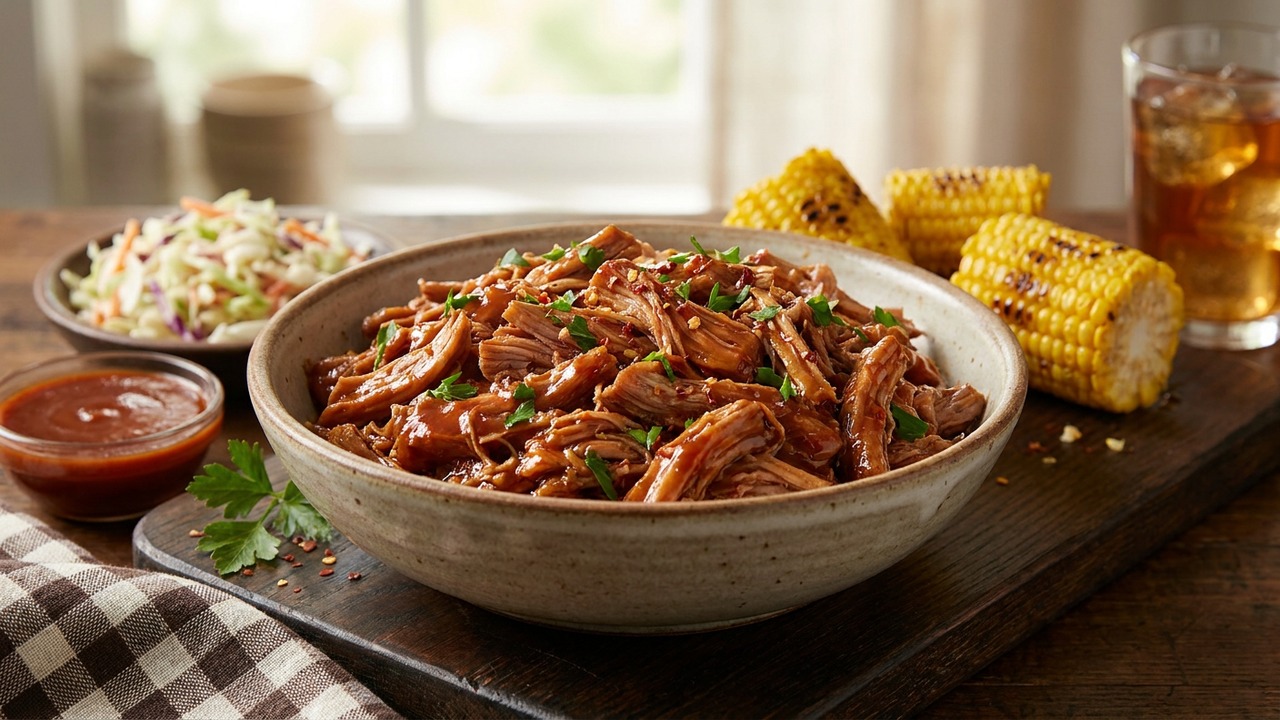
Jake Woods's note
"This is a dependable, weekender-style recipe that shines at backyard gatherings and Sunday dinners. Home cooks will appreciate the straightforward rub and the bright vinegar sauce that keeps each bite balanced."
About This Recipe
This pulled pork shoulder is classic Carolina at heart but tuned for the even, hands-off heat of a pellet smoker. A bone-in Boston butt slow-smoked at 225°F develops a deep mahogany bark and a gelatinous, rendered fat cap that keeps the meat lush; when it’s finished to 200–205°F and rested, the result is tender, shreddable pork with pockets of pure pork flavor. The apple‑cider vinegar both in the spritz and as a finishing sauce is crucial—its acidity cuts through the pork’s richness and brightens the palate, so every bite stays lively rather than cloying.
What makes this version sing is its simplicity: a mustard binder to lock the rub, brown sugar and smoked paprika for balanced sweet-smoky notes, and patient spritzing to develop a glossy, flavorful bark. Wrapping at the stall and letting the shoulder rest with its juices are the quiet moves that turn measured smoke into pull-apart tenderness. This recipe is for the home pitmaster who enjoys the ritual of low-and-slow smoking and wants reliably tender results for a backyard gathering, potluck, or a week of dinner-ready pulled pork sandwiches.
Ingredients for Traeger‑Style Pulled Pork Shoulder (Low and Slow) with Carolina Vinegar Sauce
- 5 lb Pork shoulder (Boston butt), bone-in
- 2 tbsp Yellow mustard (as binder)
- 2 tbsp Kosher salt
- 1 tbsp Coarse black pepper
- 3 tbsp Brown sugar (packed)
- 2 tsp Smoked paprika
- 1 tbsp Garlic powder
- 2 cups Apple cider vinegar (for spritz and sauce)
- 1 tsp Crushed red pepper flakes
How to Make Traeger‑Style Pulled Pork Shoulder (Low and Slow) with Carolina Vinegar Sauce
Step 1: Trim and apply binder + dry rub
Trim excess loose fat from the pork shoulder but leave a good fat cap for moisture. Rub the entire shoulder with yellow mustard to act as a binder, then evenly coat with a mix of kosher salt, black pepper, brown sugar, smoked paprika and garlic powder; press the rub into the meat and let rest 20–30 minutes at room temperature or refrigerate up to overnight.For this step
- 5 lbPork shoulder (Boston butt), bone-in
- 2 tbspYellow mustard (as binder)
- 2 tbspKosher salt
- 1 tbspCoarse black pepper
- 3 tbspBrown sugar (packed)
- 2 tspSmoked paprika
- 1 tbspGarlic powder
Step 2: Preheat pellet smoker and set up
Preheat your pellet smoker (Traeger-style) to 225°F (107°C) and use mild fruit wood or hickory pellets for a balanced smoke. Place a foil-lined drip pan under the grill grate where the pork will sit, insert a probe thermometer into the thickest part of the shoulder (avoiding bone), and place the shoulder on the grates fat cap up.Step 3: Smoke low-and-slow and spritz
Smoke the shoulder at 225°F, leaving the lid closed as much as possible. Beginning after the first 60–90 minutes, spritz the meat every 45–60 minutes with apple cider vinegar (in a spray bottle) to keep the surface moist and encourage a deep mahogany bark; smoke until the internal temp reaches about 165°F (74°C), usually 4–6 hours depending on size.For this step
- 2 cupsApple cider vinegar (for spritz and sauce)
Step 4: Wrap and finish to tenderness
When the shoulder hits the stall (around 160–170°F) wrap it tightly in foil or butcher paper—add a few tablespoons of the apple cider vinegar into the wrap if desired—and return to the smoker. Continue cooking until the internal temperature reaches 200–205°F (93–96°C) and the meat is very tender and probe-tender (probe should slide in like butter), typically another 2–4 hours.Step 5: Rest and pull
Remove the wrapped shoulder and let it rest for 45–60 minutes in a cooler or an oven set to 140°F wrapped in a towel to retain heat. Unwrap, reserve the juices, shred the pork with forks or meat claws, discarding large pieces of fat and bone, then toss the shredded meat with some reserved juices for moisture and flavor.Step 6: Make Carolina vinegar sauce and serve
Whisk together the apple cider vinegar with crushed red pepper flakes, a pinch of the same kosher salt and black pepper to taste, and a small spoonful of brown sugar if you like a touch of sweetness. Serve the pulled pork hot with the vinegar sauce on the side or lightly tossed into the meat—this bright, tangy sauce is classic with coleslaw and plain white bread for authentic Carolina style.For this step
- 1 tspCrushed red pepper flakes


- Trim excess loose fat from the pork shoulder but leave a good fat cap for moisture. Rub the entire shoulder with yellow mustard to act as a binder, then evenly coat with a mix of kosher salt, black pepper, brown sugar, smoked paprika and garlic powder; press the rub into the meat and let rest 20–30 minutes at room temperature or refrigerate up to overnight.
- Preheat your pellet smoker (Traeger-style) to 225°F (107°C) and use mild fruit wood or hickory pellets for a balanced smoke. Place a foil-lined drip pan under the grill grate where the pork will sit, insert a probe thermometer into the thickest part of the shoulder (avoiding bone), and place the shoulder on the grates fat cap up.
- Smoke the shoulder at 225°F, leaving the lid closed as much as possible. Beginning after the first 60–90 minutes, spritz the meat every 45–60 minutes with apple cider vinegar (in a spray bottle) to keep the surface moist and encourage a deep mahogany bark; smoke until the internal temp reaches about 165°F (74°C), usually 4–6 hours depending on size.
- When the shoulder hits the stall (around 160–170°F) wrap it tightly in foil or butcher paper—add a few tablespoons of the apple cider vinegar into the wrap if desired—and return to the smoker. Continue cooking until the internal temperature reaches 200–205°F (93–96°C) and the meat is very tender and probe-tender (probe should slide in like butter), typically another 2–4 hours.
- Remove the wrapped shoulder and let it rest for 45–60 minutes in a cooler or an oven set to 140°F wrapped in a towel to retain heat. Unwrap, reserve the juices, shred the pork with forks or meat claws, discarding large pieces of fat and bone, then toss the shredded meat with some reserved juices for moisture and flavor.
- Whisk together the apple cider vinegar with crushed red pepper flakes, a pinch of the same kosher salt and black pepper to taste, and a small spoonful of brown sugar if you like a touch of sweetness. Serve the pulled pork hot with the vinegar sauce on the side or lightly tossed into the meat—this bright, tangy sauce is classic with coleslaw and plain white bread for authentic Carolina style.
Traeger‑Style Pulled Pork Shoulder (Low and Slow) with Carolina Vinegar Sauce Tips
Trim, keep the fat cap
Remove loose flaps of fat but preserve a ¼–½-inch fat cap to baste the meat during the long cook and prevent dryness.
Use mustard as binder
Yellow mustard won’t flavor strongly once smoked but gives the rub something to adhere to so spices form a uniform bark.
Probe placement matters
Insert your thermometer into the thickest part of the shoulder avoiding the bone for an accurate read—bone can give falsely high temps.
Spritz for better bark
Start spritzing after the first hour and every 45–60 minutes to keep the surface moist and promote Maillard reactions; apple cider vinegar adds tang and helps the rub set.
Wrap at the stall
When temps plateau around 160–170°F, wrap in foil or butcher paper with a splash of ACV to speed through the stall while preserving moisture and bark.
Traeger‑Style Pulled Pork Shoulder (Low and Slow) with Carolina Vinegar Sauce Variations and Substitutions
Boneless shoulder
Use a 4–5 lb boneless pork shoulder and reduce total cook time slightly; probe tenderness is a better doneness cue than clock time.
South Carolina mustard sauce
For a mustard-forward twist, add ½ cup yellow mustard, 2 tbsp honey and a splash of apple cider vinegar to the sauce for a classic mustard BBQ profile.
Sweeter brown sugar glaze
If you prefer a sweeter finish, mix reserved juices with an extra tablespoon of brown sugar and brush over shredded pork before serving to create a glossy, sticky coating.
Lower-acidity option
If you find straight ACV too sharp, cut it 50/50 with apple juice or use white wine vinegar for a milder tang in the spritz and sauce.
How to Store and Make Traeger‑Style Pulled Pork Shoulder (Low and Slow) with Carolina Vinegar Sauce Ahead
Cool pulled pork to room temperature no longer than two hours, then refrigerate in an airtight container for up to 4 days or freeze for 2–3 months in vacuum-sealed bags. Save the juices and fold a few tablespoons back into the meat before storing to preserve moisture. Reheat gently in a low oven (250°F) covered with foil and a splash of reserved juices, or steam in a covered skillet over low heat until warmed through to avoid drying.
What to Serve With Traeger‑Style Pulled Pork Shoulder (Low and Slow) with Carolina Vinegar Sauce
Serve on soft hamburger buns or plain white bread with a heap of crisp coleslaw for classic Carolina contrast; pickle slices or pickled red onions add bright acidity and crunch. Complement with baked beans, skillet cornbread or potato salad and an ice-cold pale ale, sweet tea, or a citrusy bourbon cocktail to balance the vinegar tang.
Traeger‑Style Pulled Pork Shoulder (Low and Slow) with Carolina Vinegar Sauce FAQs
Why use yellow mustard as a binder?
Yellow mustard helps the dry rub adhere without leaving a distinct mustard flavor after smoking; its acidity also helps the rub meld into the meat to form a consistent bark.
What does ‘the stall’ mean and how do I know it’s happening?
The stall is when internal temp plateaus—usually around 160–170°F—because evaporation cools the meat as moisture leaves; you'll see temps hold for an hour or more before rising again, and that’s the cue to wrap if you want to accelerate finishing.
Can I skip spritzing with apple cider vinegar?
You can, but spritzing helps keep the surface moist, encourages a darker bark, and adds acidity; if you prefer not to spray, occasional mopping or adding liquid when you wrap will help retain moisture.
How do I tell when the pork is done besides thermometer temp?
Beyond 200–205°F, look for probe tenderness—the thermometer or probe should glide into the meat with almost no resistance, and the shoulder should pull apart cleanly when rested.
Should I remove the bone before shredding?
Remove the bone after resting and before shredding; it will come away easily and shredding around the bone while hot is messy and unnecessary.
About the author
Jake WoodsHello, I'm Jake. I started this recipe site with the idea that I hated recipe websites that overwhelm you with long stories and ads just to see plain content that's not helpful. My goal is to provide you with quality recipes, simple ideas and a fun cooking experience. There's lots of fun things to cook, and I think as you browse the site you'll find that TopShelf.Recipes is the place for quality recipes on the web.
See all recipes by Jake Woods →Ratings & Reviews
Did you make this recipe?
Be the first to share your experience.
Nutrition Facts
Per serving: 5 oz shoulder
Nutrition values are estimated from USDA ingredient data and may vary based on preparation, brands, and portion sizes. Values are provided for informational purposes only.
Keep Reading
Guides & articles for this recipe
Guides
Outdoor Food Safety 101
A practical, science-backed guide for hosts to plan cook-to-serve timelines, monitor safe internal temperatures, prevent cross-contamination, and keep hot and cold foods safe at grills, tailgates, and picnics. Includes transport and buffet checklists plus quick fixes for common delays.

Guides
Nighttime Grilling Guide: Light, Low-Heat, Recipes
A practical guide to grilling after dark covering lighting and safety gear, low-heat cooking techniques, insect- and weather-proofing, and easy late-summer recipes. Learn cast-iron finishes, foil-packet meals, and indirect roasts plus 8–10 night-friendly recipes and menu ideas for relaxed late-summer cookouts.
Guides
Labour Day Smoking Playbook
Seven ready-to-run smoke-first menus with exact start/hold/serve timelines so you can plan an overnight pit and a stress-free Labour Day spread. Includes make-ahead side pairings, cooler-transport tips, fuel and wood picks for late-summer weather, and safety + hold strategies so hosts can relax and enjoy the holiday.
More from Smoking
View all Smoking recipes →
Smoked Chex Mix

Smoked Coffee-Chile Rubbed Pork Roast for Pellet or Offset Smokers

Smoked Pizza with Smoked Mozzarella

Smoked Pulled Pork Meal Prep

Eggs Benedict Pulled Pork

Smoked BBQ Beef Meatballs with Cherry Chipotle Glaze

Traeger Burnt Ends from Brisket Tips with Molasses Glaze

Campfire‑Smoked Potato Salad with Mustard‑Bacon Vinaigrette — A Labor Day Grilling Side for Steak

Smoked Chocolate Cake
Ask me anything about this recipe — substitutions, scaling, techniques, timing.
Powered by AI · 6 questions per 5 minutes, 30 per day