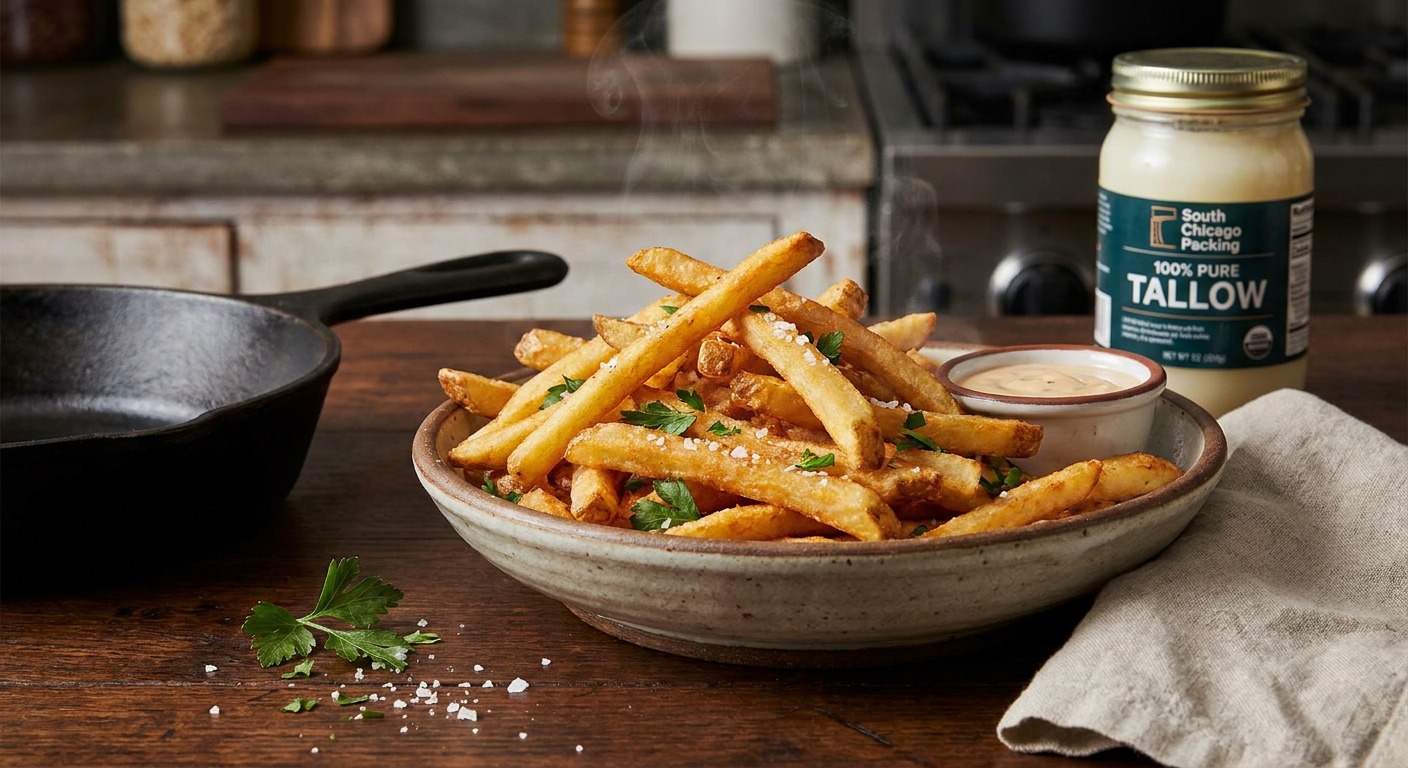
South Chicago Packing 100% Pure Tallow-Fried French Fries
Twice-fried, deep-crisp French fries cooked in beef tallow for exceptional crunch and rich, savory flavor. This stovetop method uses South Chicago Packing 100% Pure tallow to deliver restaurant-quality fries at home.
Ingredient Spotlight
South Chicago Packing 100% Pure
This likely refers to 100% pure lard (rendered pork fat) sold under the South Chicago Packing brand, a traditional cooking fat used in American, Mexican, and European cuisines. It has a mild, slightly porky aroma and a silky texture that gives excellent flakiness to pastries and a high smoke point for frying. You can find it at Latin markets, specialty butchers, or some supermarkets (often labeled as lard or leaf lard); substitute with vegetable shortening or a neutral oil for frying, or chilled butter/shortening blends for pastry, keeping in mind the flavor and texture will change.
(paid link) — as an Amazon Associate we earn from qualifying purchases.
Jake Woods's note
"These fries shine when you want something indulgent and deeply savory—perfect for game day or a weekend treat. The twice-fry method with South Chicago Packing 100% Pure tallow gives a golden, airy interior and an unbeatable crust."
About This Recipe
There’s a reason old-school steakhouses and Chicago taverns leaned on beef tallow: it delivers a savory, borderline-meaty crunch that neutral vegetable oils can’t match. These twice-fried russets—soaked to strip starch, dusted with a whisper of cornstarch, and cooked low then hot—make the most of South Chicago Packing 100% Pure tallow’s high smoke point and rich mouthfeel. The result is a contrast you can feel: a paper-thin, glassy crust that snaps, giving way to a light, fluffy interior. The flavor profile is deeper and more rounded than ordinary fries, with a faint beefy aroma that pairs brilliantly with bold condiments or simply a flake salt finish.
This stovetop method is purposely accessible: you don’t need a fryer, just a heavy pot, a thermometer, and patience for the two-stage cook. Timing and small batches are the secrets—crowding lowers the oil and creates steam, which kills crispness. Keep a clean wire rack for draining, season while the fries are hot so salt adheres, and don’t toss the strained tallow; it stores beautifully and can be reused to flavor future batches or to boost roast potatoes and pan sauces.
Ingredients for South Chicago Packing 100% Pure Tallow-Fried French Fries
How to Make South Chicago Packing 100% Pure Tallow-Fried French Fries
Step 1: Cut and soak the potatoes
Peel (optional) and cut russets into 3/8–1/2 inch (1–1.2 cm) sticks for classic fries. Immediately transfer cut fries into a large bowl of ice water and soak at least 30 minutes (or up to 2 hours) to remove surface starch and prevent discoloration.For this step
- 2 lbRusset potatoes
- 6 cupsIce water
Step 2: Dry and dust with cornstarch
Drain the potatoes and spread on a clean kitchen towel or paper towels; pat completely dry. Transfer to a large bowl, sprinkle with 1 tablespoon cornstarch, and toss lightly to coat—this thin coating helps form an extra-crispy crust during frying.For this step
- 1 tbspCornstarch
Step 3: First (blanch) fry in tallow
In a heavy 4–6 quart pot or Dutch oven, warm South Chicago Packing 100% Pure tallow to 300°F (150°C) using a deep-fry thermometer. Working in batches, fry the potatoes for 4–6 minutes until they are softened and pale (not browned). Remove with a slotted spoon to a wire rack or baking sheet lined with paper towels and let cool 10–20 minutes.For this step
- 2 1/2 cupsSouth Chicago Packing 100% Pure
Step 4: Rest and reheat tallow
While the fries rest, raise the tallow heat to 375°F (190°C). Allow the oil temperature to stabilize—this higher second temperature is key to achieving the crisp exterior without overcooking the interior.Step 5: Second fry, season, and serve
Fry the cooled fries again in batches at 375°F (190°C) for 2–3 minutes until deeply golden and crisp. Drain briefly on a wire rack, immediately season with kosher salt and freshly ground black pepper to taste, toss with chopped parsley if using, and serve hot. Reserve strained tallow for future use—store in an airtight container once cooled.For this step
- 1 1/2 tspKosher salt
- 1/2 tspFreshly ground black pepper
- 2 tbspFresh parsley (optional, chopped)


- Peel (optional) and cut russets into 3/8–1/2 inch (1–1.2 cm) sticks for classic fries. Immediately transfer cut fries into a large bowl of ice water and soak at least 30 minutes (or up to 2 hours) to remove surface starch and prevent discoloration.
- Drain the potatoes and spread on a clean kitchen towel or paper towels; pat completely dry. Transfer to a large bowl, sprinkle with 1 tablespoon cornstarch, and toss lightly to coat—this thin coating helps form an extra-crispy crust during frying.
- In a heavy 4–6 quart pot or Dutch oven, warm South Chicago Packing 100% Pure tallow to 300°F (150°C) using a deep-fry thermometer. Working in batches, fry the potatoes for 4–6 minutes until they are softened and pale (not browned). Remove with a slotted spoon to a wire rack or baking sheet lined with paper towels and let cool 10–20 minutes.
- While the fries rest, raise the tallow heat to 375°F (190°C). Allow the oil temperature to stabilize—this higher second temperature is key to achieving the crisp exterior without overcooking the interior.
- Fry the cooled fries again in batches at 375°F (190°C) for 2–3 minutes until deeply golden and crisp. Drain briefly on a wire rack, immediately season with kosher salt and freshly ground black pepper to taste, toss with chopped parsley if using, and serve hot. Reserve strained tallow for future use—store in an airtight container once cooled.
South Chicago Packing 100% Pure Tallow-Fried French Fries Tips
Precise Thermometer Use
Trust the thermometer—300°F for the blanch and 375°F for the finish are not arbitrary; they let the interior cook before the crust forms, so don’t rely on sight alone.
Dry Thoroughly First
After soaking, let the cut fries air-dry on a rack or towels for several minutes and pat them completely dry; any surface moisture will steam and soften the crust.
Don’t Crowd the Pot
Fry in small batches so the oil temperature recovers quickly; overcrowding causes soggy, greasy fries instead of crisp ones.
Light Cornstarch Dusting
Use only a tablespoon of cornstarch for 2 pounds of potatoes and toss gently—too much creates a gummy coating, but a thin film promotes a glassy, crisp shell.
Strain and Save Tallow
Cool the strained fat slightly and pass it through cheesecloth into a jar; refrigerated tallow keeps for months and adds instant flavor to future fries or roasted veg.
South Chicago Packing 100% Pure Tallow-Fried French Fries Variations and Substitutions
Sweet Potato Adaptation
Use drier orange-fleshed sweet potatoes, shallowly parboil or blanch a minute longer at 300°F, and watch closely during the second fry since their sugars brown faster.
Herb & Parmesan Finish
Toss hot fries with finely grated Parmesan, chopped parsley, and a pinch of garlic powder immediately off the rack for a savory, restaurant-style finish.
Thick-Cut Steak Fries
Cut 3/4–1 inch wedges and lengthen the first fry until the centers are tender; finish at the same temperature longer to get a golden brown exterior without overcooking the interior.
Lower-Fat Oven Finish
Parboil and dry the fries, roast them at high heat with a tablespoon of melted tallow until starting to color, then flash-fry or air-fry for 3–5 minutes to crisp and finish.
How to Store and Make South Chicago Packing 100% Pure Tallow-Fried French Fries Ahead
Leftover fries are best eaten the same day; store cooled fries in an airtight container lined with a paper towel in the refrigerator for up to 48 hours. Reheat in a 400–425°F oven or 375–400°F air fryer until crisp—avoid the microwave or they’ll turn limp. Strained tallow can be kept in a sealed jar in the fridge for several months or at cool room temperature for weeks, and it’s fine to reuse a few times after each straining.
What to Serve With South Chicago Packing 100% Pure Tallow-Fried French Fries
Serve these fries alongside a charred burger, a sliced steak frites, or a crispy fried chicken sandwich to let their beefy richness shine. Offer a trio of sauces—smoked-ketchup, lemon-garlic aioli, and malt vinegar—plus a sprinkle of flaky salt and chopped parsley for color. For drinks, they pair well with a hoppy IPA or a bold red wine like Malbec, and for casual fare a cold cola or milkshake makes a classic counterpoint.
South Chicago Packing 100% Pure Tallow-Fried French Fries FAQs
Can I leave the potato skins on?
Yes—skins add texture and flavor; scrub the potatoes well, cut slightly larger pieces if keeping skins, and be sure to soak and dry thoroughly because skins can trap extra moisture.
Why do my fries go limp after frying?
Common causes are overcrowding, not drying the potatoes well enough, or stacking fries while they cool which traps steam; use a wire rack, fry in small batches, and serve right away for the best crispness.
How many times can I reuse the tallow?
You can typically reuse tallow several times if you strain it after each use and store it cleanly; discard it if it becomes dark, foamy, or develops an off smell or flavor.
What if I don’t have a thermometer?
Test oil with a wooden spoon or chopstick: if bubbles steadily stream from the wood, the oil is hot; a few gentle bubbles indicate lower temperatures around the blanch setting, while vigorous bubbling means it’s closer to the finishing temperature—use a timer and visual checks if necessary.
Why add cornstarch, and can I skip it?
Cornstarch creates a very thin, crisp coating that promotes a glassy crust—skip it if you prefer a more rustic fry, but the texture will be less uniformly crunchy.
About the author
Jake WoodsHello, I'm Jake. I started this recipe site with the idea that I hated recipe websites that overwhelm you with long stories and ads just to see plain content that's not helpful. My goal is to provide you with quality recipes, simple ideas and a fun cooking experience. There's lots of fun things to cook, and I think as you browse the site you'll find that TopShelf.Recipes is the place for quality recipes on the web.
See all recipes by Jake Woods →Ratings & Reviews
Did you make this recipe?
Be the first to share your experience.
Nutrition Facts
Per serving: 1 serving
Nutrition values are estimated from USDA ingredient data and may vary based on preparation, brands, and portion sizes. Values are provided for informational purposes only.
Keep Reading
Guides & articles for this recipe

Healthy Eating
Gluten-Free Weeknight Grilling Plan
A 7-day gluten-free weeknight grilling plan with quick, family-friendly recipes, prep-ahead timelines, and a printable shopping list that spotlights late-summer produce and pantry staples. Includes clear cross-contamination safety tips and simple swaps to keep dinners fast and crowd-pleasing.

Healthy Eating
Low-Fat Grill Swaps for Big Flavor
A practical guide to trimming fat from grilled meals without losing juiciness or char. Learn yogurt- and citrus-based marinades, lean protein picks, searing and indirect-heat tricks, plus 5 quick low-fat marinades and a simple weeknight plan.

Recipes
DIY Edible Monster Eyes Candy
Make safe, fun edible monster eyes for cupcakes, cookies, and candy trays. Step-by-step recipes show baking-soda balls, chocolate and fondant eyes, wafer-print options, plus assembly, storage, and kid-friendly safety tips.
More from Stovetop
View all Stovetop recipes →
One-Pot Beef Bolognese

Stovetop Dutch-Oven Herb-Crusted Beef Roast with Pan Gravy

Dubai Tacos

Italian-Style Pot Roast with Tomatoes Olives and Fresh Herbs

Labor Day Grilled Lobster Rolls with Charred Scallion Brown Butter & Lemon‑Herb Aioli

Hainanese Chicken Rice

Pad Krapow Pork

Twice-Fried Restaurant Style Crispy Sweet Potato Fries (Stovetop Deep Fry)

Xiao Long Bao Soup Dumplings
Ask me anything about this recipe — substitutions, scaling, techniques, timing.
Powered by AI · 6 questions per 5 minutes, 30 per day